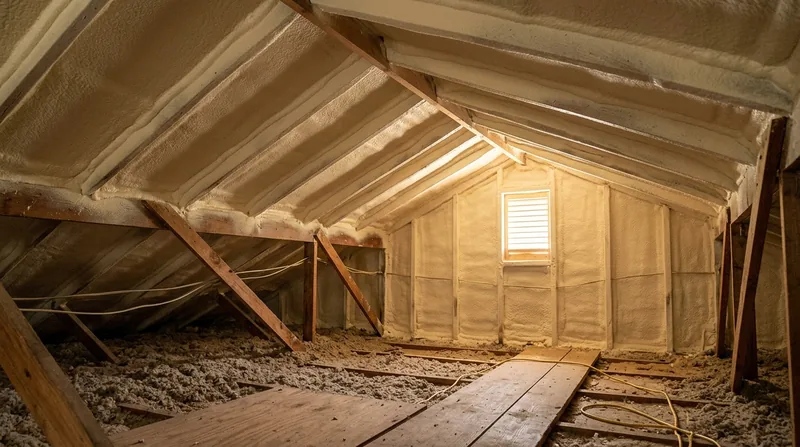




Attic spray foam insulation in Lakeland stops your cooling system from fighting humid outside air that vented attics pull in year-round. Lakeland sits in IECC climate zone 2A, where long hot summers and persistent moisture make the attic the weakest link in your home's envelope. Vented attics in block homes and newer subdivisions along the I-4 corridor toward Winter Haven and Bartow leak conditioned air and draw in damp outside air, driving cooling bills through a season that never really ends. Sealed attics with spray foam and air sealing stop that cycle. We measure each job on site, specify R-value and thickness in writing, and control the installation so the foam cures properly and your home stays comfortable without the chemical smell that marks rushed or oversized applications.
Why Sealed Attics Matter in Lakeland's Hot, Humid Climate
Lakeland's housing stock ranges from older bungalows near Lake Hollingsworth and Lake Mirror to mid-century block homes and newer subdivisions strung along the I-4 corridor. Most sit on a slab on grade with vented attics that pull in hot, humid air for most of the year. That moisture load sits directly above your block walls and ductwork, forcing your cooling system to work harder and longer. A sealed attic with closed-cell or open-cell spray foam stops the inflow, lowers your cooling load, and keeps humidity out of the spaces where it drives energy waste and comfort complaints.
- We seal the attic floor and roofline so your air conditioning stops fighting outdoor humidity and heat.
- Spray foam adheres to rafters, joists, and irregular surfaces that fiberglass and blown-in cannot reach or seal.
- A properly installed attic foam layer creates an air barrier that stops convective heat loss and moisture infiltration.
- Closed-cell foam on the roof deck lets you condition the attic space itself, eliminating the hottest zone in your home.
The result is lower cooling bills, more consistent indoor temperatures, and an attic that stays dry and stable through Lakeland's hurricane season from June through November.
Key info: Lakeland building code requires a thermal barrier (typically drywall or intumescent paint) between spray foam and living space. The fifteen-minute thermal barrier distinction matters, and your local building department in Lakeland, Winter Haven, Bartow, or Auburndale will specify which type applies to your address. We follow the code in force at your location and defer all permitting questions to the building official. For code details, contact your city building department or visit the Florida Building Code website.
How We Install Attic Spray Foam Insulation in Lakeland
Our process starts with a site visit to measure the attic, identify air leaks around ductwork and penetrations, and assess the existing insulation and substrate. We specify the foam type (closed-cell or open-cell), thickness in inches, and resulting R-value in a written estimate before any work begins. We remove old or failed insulation if needed, seal gaps and cracks with foam, and apply the specified thickness in controlled passes so the foam cures properly without off-gassing into your home.
- We visit your attic, measure the space, and identify all air leaks and thermal weak points.
- We provide a written estimate naming the foam type, thickness in inches, R-value, and total board feet.
- We remove existing insulation if it is settled, damaged, or incompatible with the new foam application.
- We seal rim joists, band joists, and ductwork penetrations with spray foam and caulk to stop air leakage.
- We apply the specified foam in controlled thickness passes, maintaining proper drum temperature and mix ratio.
- We provide mechanical ventilation during cure and specify a re-entry window of twenty-four to forty-eight hours.
The result is a sealed, insulated attic with a written record of what was installed and why.
Local example: A mid-century block home in Lakeland with a vented attic and settled fiberglass typically has air leaks around the ductwork, rim joists, and soffit vents. We seal those leaks with closed-cell foam, apply four to six inches of closed-cell to the roof deck, and create a sealed attic that stops the humid outside air from infiltrating. The same approach works in Auburndale, Plant City, and Mulberry, where block construction dominates and cooling loads run high through a long season.
Attic Spray Foam Insulation Methods and Materials
| Approach | Description | Best for |
|---|---|---|
| Closed-Cell Spray Foam on Roof Deck | High-density foam applied to the underside of the roof sheathing, creating a sealed attic space that can be conditioned. | Hot climates where the attic will be cooled or where moisture control is critical. Typical thickness is 4 to 6 inches for R-21 to R-38. |
| Closed-Cell Spray Foam on Attic Floor | High-density foam applied between joists or over the existing attic floor, creating an air barrier and thermal break. | Retrofit of existing attics where the attic will remain vented and unconditioned. Typical thickness is 3 to 5 inches for R-18 to R-30. |
| Open-Cell Spray Foam on Attic Floor | Low-density foam applied between joists or over the existing attic floor, allowing vapor permeability and sound dampening. | Budget-conscious retrofit where the attic will remain vented and dry. Typical thickness is 5 to 7 inches for R-19 to R-26. |
| Foam Plus Blown-In Fiber | Spray foam applied to seal air leaks and gaps, followed by blown-in fiberglass or cellulose to reach target R-value at lower cost. | High-R applications (R-49 or above) where foam alone would be expensive. Foam handles air sealing, fiber handles depth. |
Each approach trades cost, R-value, moisture control, and air-sealing performance. We recommend the method that fits your attic condition, your climate zone, and your budget, and we explain the trade-offs in writing before work begins.
Attic Spray Foam Insulation Cost in Lakeland: What to Expect
Attic spray foam insulation in Lakeland typically starts at $1.50 per square foot for open-cell foam on the attic floor and rises to $3.00 to $4.00 per square foot for closed-cell foam on the roof deck. The final cost depends on attic size, the type and thickness of foam, the condition of existing insulation, access difficulty, and whether the attic is vented or will be sealed. A typical 1,500-square-foot home with a 1,000-square-foot attic and a closed-cell sealed roof deck might run $3,000 to $4,000 before any removal of existing insulation or thermal barrier installation.
Factors that move the price up include large attic area, difficult access (narrow attic openings, low headroom), existing insulation that must be removed, extensive air sealing around ductwork and penetrations, and the need for a thermal barrier coat or drywall. Factors that keep it reasonable include straightforward access, simple attic geometry, and a decision to leave existing fiberglass in place if it is dry and not in the way of the new foam. We measure the job on site and provide a written estimate with R-value and thickness before any commitment. For a detailed pricing breakdown and examples from your specific address, see our full pricing page.
Homeowners in Lakeland, Winter Haven, Bartow, and Auburndale often compare three to four estimates before deciding. Get estimates from at least two other contractors so you can see the differences in approach, foam type, thickness, and price. The cheapest estimate is rarely the best one, especially if it includes no R-value specification, no thickness in inches, no mention of ventilation during cure, or a price far below market.
What to Look for When Hiring a Spray Foam Insulation Contractor Near Lakeland
A reputable spray foam contractor near Lakeland will provide a written estimate with R-value and thickness specified, explain the foam type and why it fits your attic, and be reachable after the job is done. Verify that the contractor is fully insured and that the insurance is active and covers spray foam work. Ask for references from homes in Lakeland or nearby cities where the contractor has sealed attics, and follow up with at least one. Check whether the contractor is registered with your city or county, since permitting and contractor registration vary from Lakeland to Winter Haven to Bartow and there is no reciprocity across city lines.
- Confirm that the contractor is fully insured and can provide a current certificate of insurance covering spray foam application.
- Request a written estimate that names the foam type, thickness in inches, R-value, total board feet, and the scope of air sealing.
- Ask about the contractor's ventilation setup during cure and the re-entry window they recommend before occupancy.
- Verify that the contractor will remove existing insulation if needed and will not spray over wet, contaminated, or leaking substrates.
- Check that the contractor understands local building code, including thermal barrier requirements and any permitting that applies at your address.
- Ask whether the contractor has experience with sealed attics in Lakeland's climate and can explain why sealed attics make sense for your home.
A contractor who avoids these questions, offers a price with no R-value or thickness, promises immediate re-entry, or cannot verify insurance is a sign to walk away. For a free estimate and to discuss your attic with a local contractor, contact us at (863) 777-4948 or use our online form.
Related Spray Foam Services in Lakeland
Attic spray foam often pairs with air sealing around rim joists and band joists, especially in older bungalows near the lakes where crawl spaces still exist. Many homes also benefit from closed-cell spray foam on the roof deck if the attic will be conditioned, or open-cell spray foam if budget is the priority. Metal buildings, workshops, and pole barns in Polk County benefit from closed-cell foam on the roof deck and walls to control condensation and moisture. For mid-century block homes with poor wall insulation, injection foam into existing wall cavities can improve comfort without demolition.
Attic Spray Foam Insulation in Lakeland: Pricing Guide
| Service | Price | Details |
|---|---|---|
| Open-Cell Spray Foam, Attic Floor | Starting at $1.50/sq ft | Budget option for vented attics, typical thickness 5-7 inches, includes air sealing of major leaks around ductwork |
| Closed-Cell Spray Foam, Attic Floor | Starting at $2.25/sq ft | High-performance retrofit, typical thickness 3-5 inches, creates air barrier and vapor retarder, moisture control in humid climates |
| Closed-Cell Spray Foam, Sealed Roof Deck | Starting at $3.00/sq ft | Premium sealed attic, typical thickness 4-6 inches, conditions the attic space, highest R-value and moisture control for hot humid climates |
| Insulation Removal and Replacement | On estimate | Removal of existing fiberglass, cellulose, or failed foam, substrate prep, and new foam installation quoted together based on attic condition and volume |
| Travel and Estimate | Free estimate, included travel | No charge for site visit and written estimate in Lakeland and surrounding service areas, response within 24 hours by phone or email |
Indicative pricing, the exact cost depends on square footage, finish, and site access. Free personalized estimate within 24h at (863) 777-4948.


