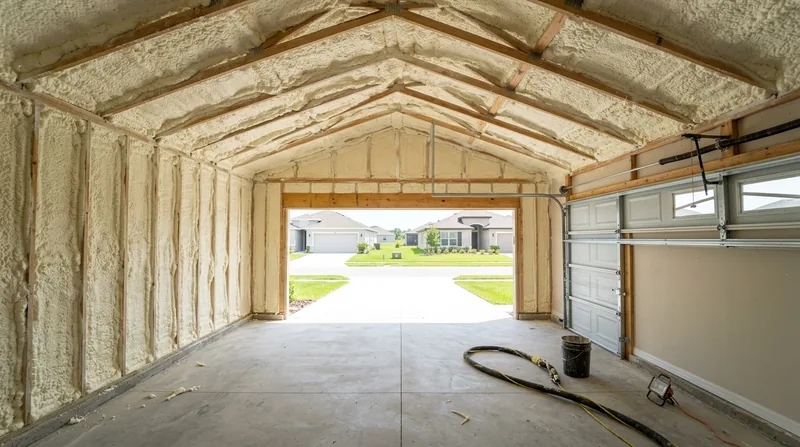




Garage spray foam insulation in Lakeland stops heat from radiating through garage ceilings and walls into the living spaces above, a problem that defines newer homes strung along the I-4 corridor from Lakeland to Winter Haven and Auburndale. Rooms over garages run hot because the garage itself sits uninsulated and unair-conditioned, absorbing the long Polk County cooling season and pushing that heat straight up through standard framing and drywall. Spray foam seals both the thermal bridge and the air leaks that let conditioned air escape downward into the garage, cutting the load on the upstairs HVAC system and stabilizing room temperature year-round. The work is straightforward, the payoff is immediate, and the cost is predictable. We'll walk you through what the job entails, how we price it, and what to look for when hiring a spray foam contractor to do it right the first time.
Why Garage Spray Foam Insulation Matters in Lakeland's Newer Subdivisions
The newer subdivisions that line I-4 between Lakeland and Auburndale were built to a price, and that price cut corners on garage thermal control. A standard garage framing detail, a rim joist, a band board, and a rim cavity, becomes a direct thermal pathway when it sits below a conditioned bedroom or living room. In Lakeland's climate, where the cooling season runs long and humidity never really lets up, that uninsulated garage becomes a heat sink. The room above it stays warm even when the thermostat is set to cool, and the air conditioning runs longer and harder to compensate.
- Spray foam on the garage ceiling creates a thermal barrier that stops radiant heat from entering the living space above.
- Closed-cell foam on garage walls and the rim joist seals air leaks that let conditioned air escape into an unconditioned space.
- The combination cuts cooling load during the six-month Polk County hot season, lowering energy use and stabilizing room temperature.
- A properly foamed garage also provides moisture control during hurricane season, when wind-driven rain and humidity drive inward through cracks and seams.
The result is a room that stays comfortable without running the air conditioning into the night, and a homeowner who stops wondering why that bedroom never cools down like the rest of the house.
Key info: Rooms over garages in Plant City, Auburndale and Lakeland's newer subdivisions run an average of 3 to 5 degrees warmer than adjacent rooms on the same floor, a difference that disappears once the garage ceiling and rim are foamed.
How Garage Spray Foam Insulation Works: The Process in Lakeland
We start with an on-site look at the garage, the rim cavity, the ceiling framing, and any existing insulation or moisture. If the substrate is sound and dry, we move forward. If there's active moisture, standing water, or a roof leak above the garage, we stop and tell you straight: foam goes over a dry surface, or it does not go on at all. Once we've cleared the moisture question, we set up mechanical ventilation, protect the living space from overspray, and spray the foam to the thickness and R-value your Lakeland home needs.
- We inspect the garage framing, rim joist, and existing insulation to identify the scope and any moisture issues before any foam is mixed.
- We set up negative pressure ventilation so that fumes are exhausted outside during application and cure, protecting your home's air quality.
- We spray the garage ceiling to a uniform thickness, typically 3.5 to 5.5 inches of closed-cell foam for R-value between R-20 and R-35.
- We foam the rim joist cavity and any exposed band board to seal air leaks and create a continuous thermal envelope.
- We apply a thermal barrier if code requires it, which varies by Lakeland address and your local building official's interpretation.
- We observe a re-entry window of 24 to 48 hours before the space is occupied, allowing the foam to cure fully.
The entire process, from setup to cleanup, typically takes one working day for a standard two-car garage. For more details on how we handle air sealing throughout your home, see our air sealing page.
Real example: A 400-square-foot garage ceiling in a Lakeland subdivision near I-4 takes about 5 to 6 hours to foam, protect, and clean. A rim joist retrofit on a block-wall garage in Bartow adds another 2 to 3 hours. We schedule the work for a day when the family can stay upstairs, away from the garage, during application and the first 24 hours of cure.
Garage Spray Foam Methods: Closed Cell vs. Open Cell
| Approach | Description | Best for |
|---|---|---|
| Closed-Cell Foam | Dense, rigid foam with an R-value around R-6 per inch. Acts as both insulation and air barrier. Resists moisture and vapor. | Garage ceilings and rim joists in Lakeland's humid climate. Provides moisture control during hurricane season. |
| Open-Cell Foam | Lighter, more flexible foam with an R-value around R-3.5 per inch. Lower cost. Allows vapor transmission. Not moisture-resistant. | Garage ceilings in dry climates or where moisture is not a concern. Rarely the right choice for Lakeland garages. |
| Closed-Cell + Air Sealing | Closed-cell foam on the ceiling and rim, plus caulk or foam sealant on penetrations, ductwork, and electrical chases. | Complete thermal and moisture control. The standard for rooms over garages in newer Lakeland subdivisions. |
| Rim-Only Retrofit | Closed-cell foam applied only to the rim joist cavity and band board, leaving the garage ceiling unfoamed. | A cost-effective first step when the room above is slightly warm but cooling bills are not yet a crisis. |
For Lakeland homes, closed-cell foam is the standard choice. It resists the moisture that Polk County's humidity and hurricane season drive into rim cavities and garage walls. Open cell is cheaper but does not perform in this climate and is rarely the right answer for a garage.
Garage Spray Foam Insulation Cost in Lakeland: What to Expect
Garage spray foam insulation in Lakeland starts at around $1,200 to $2,000 for a standard two-car garage ceiling with a rim joist retrofit. The final cost depends on the square footage of the ceiling, the depth of the rim cavity, whether the existing insulation needs to be removed first, and the R-value specification your home needs. A 400-square-foot garage ceiling typically runs between $1,500 and $2,500. If you have a three-car garage or if the rim joist cavity is deep or blocked by plumbing or electrical work, the price moves up. Removing old insulation before foam adds labor and disposal cost, typically $300 to $600 depending on the material and volume.
The best way to land on a real number is to get a written estimate that spells out the R-value, the thickness of foam, and the square footage being covered. We provide that detail at no charge, and we're ready to answer questions about why the number is what it is. Visit our pricing page for a complete breakdown of what moves the cost up or down, or call us at (863) 777-4948 for a free estimate.
Two to three estimates from different contractors will show you the market range and help you spot the outliers. A price far below market often signals that the contractor is cutting corners on thickness, ventilation during cure, or the re-entry window. A price far above market may reflect unnecessary scope or padding. The honest estimate includes the R-value, the thickness per pass, the total board feet, and a clear breakdown of labor and materials.
Garage Spray Foam Insulation Near Me: What Lakeland Homeowners Should Know When Hiring
Spray foam insulation is a specialized trade, and the difference between a careful installer and a careless one shows up weeks or months after the job is done. The right contractor will give you a written estimate with R-value and thickness, will run mechanical ventilation during application and cure, and will enforce a 24- to 48-hour re-entry window before anyone is back in the garage. The wrong contractor will spray fast, promise immediate occupancy, and disappear when the smell does not fade or the foam is too thin.
Before you hire, ask these questions:
- Request a written estimate that states the R-value, the thickness of foam per pass, and the total board feet being sprayed.
- Ask whether the contractor will run mechanical ventilation during application and provide a re-entry window in writing.
- Verify that the contractor carries general liability insurance and ask for a certificate of insurance naming your address.
- Ask for references from three recent garage spray foam jobs in Lakeland or Winter Haven, and follow up with at least one.
- Confirm what permits, if any, are required at your address and whether the contractor will help you navigate the local building department.
- Understand whether the estimate includes removal of existing insulation or if that is a separate line item.
The local independent contractor, one with a Lakeland address and local plates, is positioned against both the rig-and-run crews that spray a job in an afternoon and vanish, and the national franchises that charge premium prices and move on to the next market. What matters is honest guidance: we'll tell you if a rim-only retrofit will solve your problem or if you need the full ceiling. We'll walk away from a wet garage and tell you why. And we'll give you a number that reflects the actual work, not a price designed to seem cheap and then balloon with change orders. For more on how we approach every job, contact us for a free estimate.
Garage Spray Foam Insulation in Lakeland: Pricing Guide
| Service | Price | Details |
|---|---|---|
| Two-car garage ceiling (400 sq ft) | Starting at $1,500 | Closed-cell foam, R-20 to R-25, includes rim joist and air sealing around penetrations |
| Two-car garage with rim retrofit | Starting at $1,800 | Ceiling plus deep rim cavity, closed-cell foam, R-25 to R-35, complete thermal and moisture barrier |
| Three-car garage or complex framing | On estimate | Size, existing insulation removal, blocked cavities, and plumbing or electrical routing require on-site measurement |
| Insulation removal before foam | $300 to $600 | Labor and disposal for old fiberglass, blown-in, or settling insulation; cost depends on volume and material type |
| Service area coverage | Included | Travel to Lakeland, Winter Haven, Bartow, Auburndale, Plant City, and surrounding Polk County cities at no extra charge |
| Free written estimate | No obligation | Response within 24 hours, includes R-value and thickness specs, call (863) 777-4948 to schedule |
Indicative pricing, the exact cost depends on square footage, finish, and site access. Free personalized estimate within 24h at (863) 777-4948.


