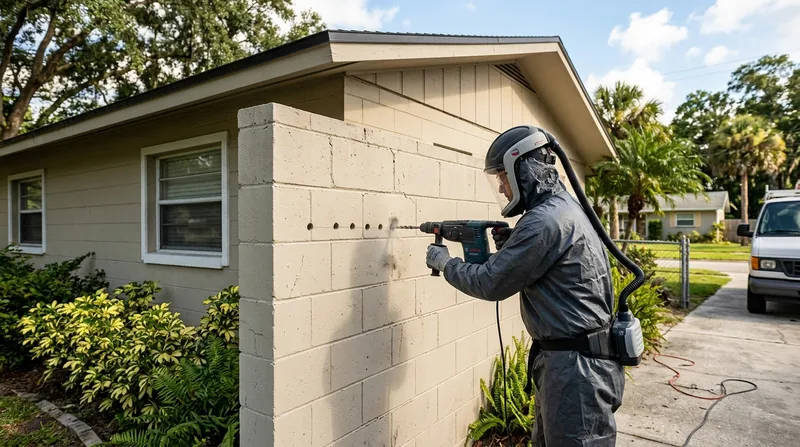




Lakeland's mid-century block homes stretch across neighborhoods from Lake Hollingsworth to the I-4 corridor toward Winter Haven and Bartow, and many of them still have wall cavities filled with insulation that settled decades ago. Wall and injection foam insulation adds R-value without tearing out drywall or exterior block, restoring thermal resistance in rooms that have grown hot and uncomfortable. In this climate zone 2A, where cooling runs nine months a year and humidity drives moisture inward most of the time, the difference between a poorly insulated wall cavity and a properly filled one shows up in your electric bill and in how your home feels. We inject closed-cell or open-cell foam directly into the existing cavity, seal air leaks, and leave the wall intact. The work is fast, contained, and delivers measurable improvement on a retrofit timeline.
Why Wall and Injection Foam Insulation Matters in Lakeland's Older Neighborhoods
Block homes built in the 1950s and 1960s around Lakeland often have 4 to 6 inches of mineral fiber or fiberglass in the wall cavities, installed when energy codes were loose and settling was not yet a recognized problem. Over fifty years, that insulation compacts, gaps open at the top and bottom of the wall, and air leaks through the cavity like water through a sieve. Injection foam fills those voids completely, restores the R-value, and seals the air path in one application. The long cooling season here means every degree of wall insulation pays for itself.
- We drill small holes through drywall or block and inject foam into each cavity section, filling from bottom to top to prevent voids.
- Closed-cell foam hardens and creates an air barrier and vapor retarder in one pass, critical in Lakeland's humid climate.
- Open-cell foam costs less and works well in walls where vapor permeability is desired, though closed-cell is the stronger choice in high-humidity zones.
- We patch all drill holes and finish flush with the existing surface, leaving no structural damage behind.
- The entire wall cavity becomes a continuous thermal and air barrier, stopping the convective loop that pulls hot air inward.
Injection foam in settled wall cavities is the retrofit answer that does not require demolition and delivers results that show up in your cooling bills and comfort from day one.
Key insight: A block wall cavity that has settled to 2 to 3 inches of effective insulation can drop to R-3 or R-4. Injection foam restores that cavity to R-10 to R-15 depending on the product, a five-fold improvement that cools rooms over garages and bedrooms on the west side in subdivisions along the I-4 near Auburndale and Bartow.
For more on how closed-cell spray foam insulation performs in high-moisture environments, see our guide to closed-cell applications across Lakeland.
How We Inject Foam into Existing Wall Cavities: The Lakeland Process
Injection foam work starts with a detailed walkthrough. We identify which walls are under-insulated, locate studs and utilities using a stud finder and thermal imaging, and plan the drill pattern to ensure complete fill with no bridging or voids. The process is straightforward, fast, and leaves your home occupiable during and immediately after the job with standard ventilation.
- We assess the wall cavity depth, existing insulation condition, and any moisture or contamination that would prevent foam application.
- We mark drill locations on the interior drywall or exterior block, spacing them 16 to 24 inches apart vertically to ensure complete fill.
- We drill 1.5-inch diameter holes and inject foam at controlled pressure and temperature, following the manufacturer ratio and drum specifications precisely.
- We monitor fill height in each cavity section and inject from bottom to top to prevent air entrapment and ensure density and R-value meet spec.
- We patch all holes with foam backer rod and spackle on drywall, or foam-compatible caulk on block, and finish to match the existing surface.
- We ventilate the space during cure (typically 24 to 48 hours) and provide a re-entry window and post-cure care instructions.
The result is a wall cavity that is fully insulated, air-sealed, and protected against moisture infiltration, all without opening the wall or losing occupancy.
Local example: A 1960s block home in Plant City with a master bedroom over an uninsulated garage shows 78 degrees on the interior wall in July while the rest of the house sits at 74. Injection foam into that wall cavity brings it down to 75 and saves 12 to 18 percent of cooling load in that zone. Same work applies to rooms along the west side of homes in Lakeland near the lakes, where afternoon sun hits uninsulated walls directly.
For details on how we handle air sealing around injection work, see our air sealing guide.
Wall Injection Methods and Foam Types
| Approach | Description | Best for |
|---|---|---|
| Closed-Cell Injection | Dense foam that hardens rigid, creates an air barrier and vapor retarder, R-6 to R-7 per inch, resists moisture penetration. | High-humidity climates, walls exposed to wind-driven rain, cavities where air sealing is critical, Lakeland's long cooling season. |
| Open-Cell Injection | Lighter foam that expands and cures soft, R-3.5 to R-3.8 per inch, vapor permeable, lower cost than closed-cell. | Interior walls where vapor permeability is acceptable, retrofit budgets, walls not exposed to exterior moisture or wind-driven rain. |
| Partial Cavity Fill | Injection to top of existing settled insulation, adding new foam only where the cavity has lost density and R-value. | Walls with some remaining insulation that have settled, cost-conscious retrofits, situations where full cavity depth is not accessible. |
| Full Cavity Injection | Complete fill of the entire cavity depth from bottom to top, removing or displacing old insulation as foam is injected. | Severely settled or contaminated cavities, maximum R-value recovery, homes where the cavity is fully accessible and permits allow removal. |
Wall and Injection Foam Insulation Cost in Lakeland: What to Expect
Injection foam pricing in Lakeland runs from $2 to $4 per square foot of wall cavity depending on foam type, cavity depth, accessibility, and the complexity of the drill pattern. A mid-sized bedroom wall cavity of 200 to 300 square feet typically costs $400 to $900 for closed-cell injection, or $300 to $600 for open-cell. Factors that affect your final price include cavity depth (deeper cavities require more material), existing insulation condition (contaminated or wet cavities cost more to assess and may require removal first), accessibility (interior walls cost less than those requiring exterior work), and whether you choose closed-cell or open-cell foam.
The best way to know your cost is to get a written estimate from us with R-value and thickness specifications for your specific walls. We provide detailed pricing guidance and can walk you through the cost difference between partial fill and full cavity work. Two to three estimates from local contractors give you confidence that you are paying fair market value and understanding what each bid includes.
Remember that injection foam is a retrofit investment, not an emergency repair. Plan the work during your off-season or when your schedule allows a 24 to 48-hour cure window with mechanical ventilation running. This timing flexibility often means better pricing and faster scheduling than rush jobs.
What to Look for When Hiring a Spray Foam Contractor Near Lakeland for Wall Injection
Wall injection foam is specialized work, and the difference between a careful installer and a careless one shows up in your energy bills and comfort for years. When you call contractors in Lakeland, Winter Haven, Bartow, or any of the surrounding areas, ask the right questions to verify that you are hiring a professional who understands the climate, the building code, and the product.
- Request a written estimate that specifies the foam type, R-value per inch, target thickness in each cavity section, and the total board feet or square feet being filled.
- Ask whether the contractor will use mechanical ventilation during cure and what re-entry window they are specifying, typically 24 to 48 hours for proper off-gassing.
- Verify that the contractor is fully insured and can provide a certificate of insurance covering general liability and completed operations.
- Check references from previous wall injection jobs in Lakeland or nearby towns, and ask specifically about cure smell, re-entry timing, and long-term comfort improvement.
- Confirm that the contractor understands local building code requirements for thermal barriers and ignition barriers, and that they will defer to the local building department on any permits or inspections your city requires.
- Ask how the contractor handles moisture detection and whether they will walk away from a wet or contaminated cavity rather than spray over it.
The local independent contractor who is reachable after the job, who gives you a detailed estimate, and who explains the cure process honestly is the one worth hiring. Avoid any estimate with no R-value, no thickness spec, and a price far below market, and be skeptical of promises of immediate re-entry or guaranteed energy savings. Contact us for a free, no-obligation estimate at (863) 777-4948, and we will walk you through the process and answer any questions about your specific walls.
Wall & Injection Foam Insulation in Lakeland: Pricing Guide
| Service | Price | Details |
|---|---|---|
| Closed-Cell Injection Foam | Starting at $2.50/sq ft | Complete fill of wall cavities with rigid foam, R-6 to R-7 per inch, air and vapor barrier included, best for humid climates |
| Open-Cell Injection Foam | Starting at $1.75/sq ft | Lightweight fill for interior walls, R-3.5 to R-3.8 per inch, vapor permeable, lower cost option for retrofit budgets |
| Partial Cavity Fill | Starting at $1.50/sq ft | Top-up injection over existing settled insulation, adds only where density has dropped, cost-effective improvement without full removal |
| Full Cavity Injection with Removal | On estimate | Complete cavity clearance and new fill required for contaminated or severely damaged insulation, site assessment determines final cost |
| Estimate and Consultation | Free | Written estimate with R-value and thickness specs, response within 24 hours, no obligation to book, call (863) 777-4948 |
Indicative pricing, the exact cost depends on square footage, finish, and site access. Free personalized estimate within 24h at (863) 777-4948.


