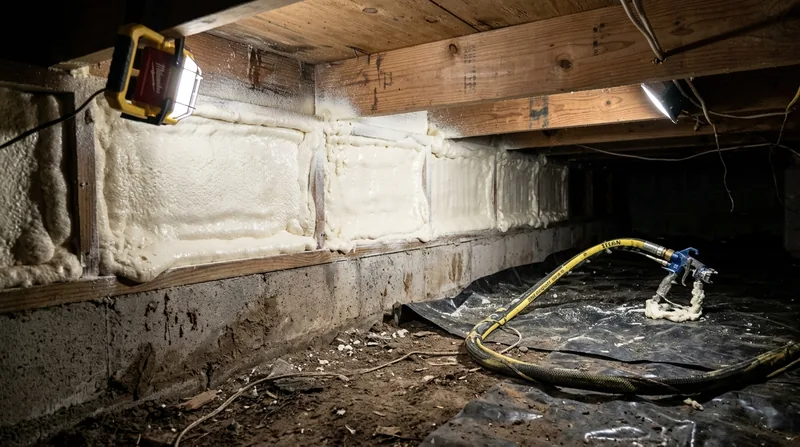




Closed cell spray foam insulation in Lakeland is a high-performance moisture and thermal barrier built for Florida's hot, humid climate. Lakeland sits in IECC climate zone 2A, where long cooling seasons and persistent humidity drive moisture inward through walls and attics year-round. Mid-century block homes scattered across town from Dixieland to the I-4 corridor toward Winter Haven and Auburndale have block wall cavities that have settled or failed, and rim joists that pull in humid air at the foundation line. Newer subdivisions along the I-4 corridor see rooms over garages run especially hot. Closed cell foam seals these cavities and adds a moisture break where it matters most, stopping both heat load and inward vapor drive. We help homeowners across Polk, Hillsborough, Pasco, Orange, Hernando and Hardee counties understand when closed cell is the right choice, how it fits into the building code, and what to expect from start to finish.
Why Closed Cell Spray Foam Matters in Lakeland's Climate
Lakeland's attics and block walls face a year-round moisture challenge. Vented attics pull in hot, humid outside air during summer cooling season, and that moisture condenses on ductwork and rim joists. Block wall cavities in homes built from the 1950s through 1970s offer little thermal resistance once original insulation settles, and rooms over garages in newer I-4 corridor subdivisions run hot because the garage below acts as a heat sink. Closed cell foam works here because it delivers high R-value per inch, it stops air leakage completely, and it creates a vapor-retarding layer inside the cavity. That combination addresses both the heat load and the moisture drive that dominates failure in this zone.
- Closed cell foam reaches R-6 to R-7 per inch, so 2 inches of closed cell matches 4 to 5 inches of fiberglass in the same space.
- It seals air leakage at rim joists and block wall cavities, stopping the humid air infiltration that fiberglass alone cannot address.
- It acts as a vapor retarder, breaking the inward moisture drive that dominates Lakeland's long cooling season.
- It adds structural rigidity to block walls and rim joists, especially in the older bungalows near Lake Hollingsworth and Lake Mirror.
These properties make closed cell the right choice for rim joists, block wall cavities, and sealed attics in Lakeland homes, and the standard for metal buildings and workshops where condensation control is the job.
Key info: Block wall cavities in Lakeland's mid-century homes from Auburndale to Bartow often show settled insulation and moisture staining. Closed cell foam injected into the cavity fills voids, seals air paths, and stops moisture from wicking inward. A typical 8-foot block wall cavity might take 1 to 1.5 inches of closed cell, depending on the cavity width and the moisture environment.
For more detail on how spray foam seals and insulates attics in this climate, see our attic spray foam insulation page. The Florida Building Code and local energy code govern the thermal barrier and ignition barrier requirements for closed cell foam, so we work with your local building department to confirm what applies at your address. The Lakeland Building Department and the building officials in Winter Haven, Bartow, Auburndale, and other cities in the service area each have their own permitting rules, so we help you navigate the specifics for your property.
How We Install Closed Cell Spray Foam in Lakeland Homes and Buildings
Closed cell foam installation starts with a site inspection to measure the cavity, confirm moisture conditions, and identify any air paths that need sealing. We specify the thickness and R-value in writing before we spray, so you know exactly what you are getting. The process involves setting up mechanical ventilation, spraying the foam in controlled passes to build the specified thickness, and maintaining the proper drum temperature and chemical ratio. The foam cures over twenty-four to forty-eight hours, and we provide a re-entry window so you know when the space is safe to occupy. We never spray over wet substrates, active leaks, or contaminated surfaces, and if the moisture situation requires fixing first, we say so and walk away from the spray until it is solved.
- We inspect the cavity, measure dimensions, and check moisture conditions before giving you a written estimate with R-value and thickness.
- We set up mechanical ventilation to manage VOC off-gassing during cure and to protect the surrounding environment.
- We spray the foam in controlled passes, holding the drum temperature and chemical ratio per the manufacturer spec, building the specified thickness in layers.
- We confirm the foam has cured and provide a re-entry window, typically twenty-four to forty-eight hours, before the space is occupied.
- We seal rim joists and block wall cavities with closed cell, and we air-seal the perimeter with tape or caulk to complete the air barrier.
This approach delivers a durable, code-compliant installation that stops heat loss and moisture infiltration for the life of the building.
Example: A homeowner in Lakeland with a 1960s block home notices hot, humid rooms and settling insulation in the attic above the master bedroom. We inspect the rim joist and block wall cavity, find moisture staining and air leakage at the block line, and recommend 1.5 inches of closed cell foam in the rim joist and a partial fill of the block cavity. We set up ventilation, spray the foam in two passes, allow forty-eight hours cure time, and seal the perimeter with foam tape. The room stays cooler, humidity drops, and the homeowner avoids the cost of a full block wall rebuild.
For a deeper look at wall and cavity foam, see our wall and injection foam page. If your home has old insulation that needs to come out first, we handle insulation removal and can coordinate the removal and re-insulation in one project.
Closed Cell Spray Foam Installation Methods
| Approach | Description | Best for |
|---|---|---|
| Rim Joist and Band Joist Sealing | Closed cell foam sprayed into the rim joist cavity at the foundation line, sealed with tape or caulk, stopping air infiltration and moisture drive at the band board. | Older Lakeland bungalows with exposed rim joists, mid-century block homes with band board gaps, newer subdivisions where the rim joist is the primary air leak path. |
| Block Wall Cavity Injection | Closed cell foam injected into block wall cavities through drilled holes, filling voids and settling insulation, restoring thermal resistance and blocking moisture. | Mid-century block homes in Lakeland, Auburndale, Bartow, and Plant City where original insulation has settled or failed and rooms run hot. |
| Sealed Attic Deck Spray | Closed cell foam sprayed directly onto the roof deck underside in an unvented attic, creating a continuous air and vapor barrier, stopping heat and humidity infiltration. | New construction, retrofits of vented attics, homes with ductwork or conditioning in the attic, and metal buildings where condensation control is critical. |
| Crawl Space and Subfloor Spray | Closed cell foam sprayed on band joists, rim joists, and rim board perimeter in crawl spaces, stopping humidity infiltration and air leakage at the foundation envelope. | Older Lakeland bungalows with crawl spaces near the lakes, homes with damp crawl spaces and humid living areas above, and properties where moisture control is the priority. |
| Metal Building and Warehouse Spray | Closed cell foam sprayed on the interior of metal roof decks and walls, stopping condensation, controlling temperature swings, and creating a vapor barrier against steel. | Polk County metal buildings, workshops, barndominiums, and warehouses where condensation and sweat on steel are the failure mode. |
Closed Cell Spray Foam Insulation Cost in Lakeland: What to Expect
Closed cell spray foam pricing in Lakeland starts at approximately $1.20 per board foot and moves up based on cavity size, access, substrate condition, and the amount of air sealing required. A typical rim joist job on a mid-century block home might run 50 to 150 board feet and land in the $600 to $1,800 range. A sealed attic retrofit on a 2,000-square-foot home with roof deck spray and air sealing can run 400 to 800 board feet and cost $4,800 to $9,600. Block wall cavity injection on a single room might be 100 to 300 board feet, $1,200 to $3,600. Metal building and warehouse jobs scale with roof and wall area, and we measure on site and provide a detailed written estimate with R-value and thickness specs before any work begins.
The main factors that move the price are the thickness you need (which depends on your R-value goal and the cavity width), the number of air sealing details around windows and doors, whether old insulation needs removal first, and the accessibility of the work. A rim joist that is easy to reach costs less than one buried in a tight crawl space. A roof deck that is clear and dry costs less than one with old blown-in insulation and moisture staining that requires removal first. We always give you multiple options so you can choose the scope and price that fits your budget and your building's needs.
For a complete breakdown of pricing by service type, see our full pricing overview. Call us at (863) 777-4948 for a free, no-obligation estimate. We respond within twenty-four hours and measure the job on site so you get a real number, not a guess.
What to Look for When Hiring a Spray Foam Insulation Contractor Near Me in Lakeland
The spray foam insulation market in Lakeland and across Polk, Hillsborough, and Pasco counties includes local independents, national franchises, and out-of-state rig-and-run crews. The difference matters because spray foam is only as good as the installation, and a bad installation leaves you with smell, off-gassing, poor coverage, and nobody to call when things go wrong. A good contractor gives you a written estimate with R-value and thickness specs, sets up mechanical ventilation during cure, allows the full re-entry window before occupancy, and is reachable after the job is done. A bad contractor quotes a price with no details, promises immediate re-entry, shows up with a trailer from out of state, sprays in an afternoon, and disappears.
- Ask for a written estimate that names the R-value per inch, the thickness in inches, and the total board feet being sprayed, plus the cost per board foot and the total labor and material.
- Verify the contractor carries full insurance and ask to see the certificate of insurance; you can verify coverage independently with the insurance company.
- Check references from at least two similar jobs in Lakeland or nearby towns, and call those homeowners and ask about smell, re-entry timing, and whether the contractor was reachable afterward.
- Confirm the contractor understands your local building code and will work with the Lakeland Building Department or the building official in your city to verify what permits and thermal barrier requirements apply.
- Ask whether the contractor will spray over wet substrates or active leaks; the only honest answer is no, and if moisture needs fixing first, the contractor should say so upfront.
- Get at least two estimates so you can compare scope, thickness, R-value, and price; the lowest price is rarely the best value.
We have been in business since 2009 and we are fully insured. We give written estimates with R-value and thickness specs, we set up mechanical ventilation, we honor the re-entry window, and we are reachable for questions after the job. Contact us for a free estimate and we will walk you through the process step by step.
Closed Cell Spray Foam Insulation in Lakeland: Pricing Guide
| Service | Price | Details |
|---|---|---|
| Rim Joist and Band Joist Sealing | Starting at $1.20/board ft | Closed cell foam sealing the rim joist cavity at the foundation line, includes air sealing tape and caulk, typical 50 to 150 board feet per job |
| Block Wall Cavity Injection | Starting at $1.20/board ft | Closed cell foam injected into block wall cavities through drilled holes, fills voids and restores thermal resistance, 100 to 300 board feet typical per room |
| Sealed Attic Roof Deck Spray | Starting at $1.20/board ft | Closed cell foam sprayed on roof deck underside in unvented attic, includes air sealing and thermal barrier, 400 to 800 board feet typical for 2,000 sq ft home |
| Metal Building and Warehouse Spray | Starting at $1.20/board ft | Closed cell foam on interior metal roof and wall decks for condensation control, scope and cost scale with building dimensions and roof area |
| Estimate | Free | On-site measurement, written specification with R-value and thickness, no obligation to book, response within twenty-four hours |
Indicative pricing, the exact cost depends on square footage, finish, and site access. Free personalized estimate within 24h at (863) 777-4948.


