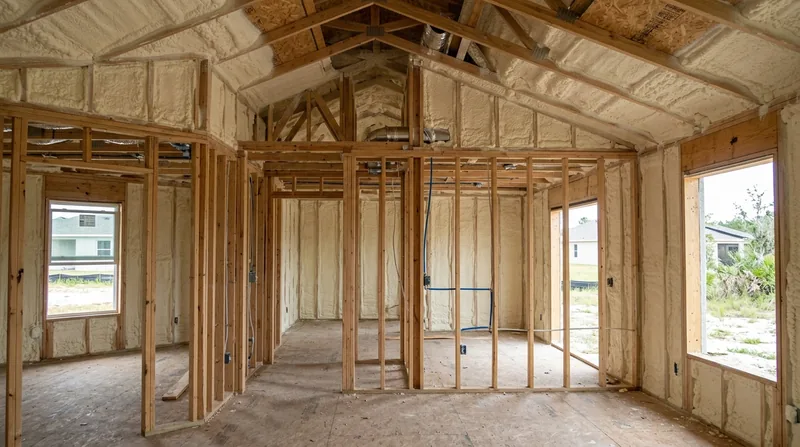




Commercial & New Construction Spray Foam in Lakeland takes the moisture battle seriously from day one. Polk County's mid-century block homes, newer I-4 corridor subdivisions, and industrial metal buildings all face the same climate challenge: long hot humid summers in IECC zone 2A, where damp outside air gets pulled into vented attics and moisture drives inward through walls most of the year. New construction and retrofit commercial projects across Lakeland, Winter Haven, Bartow, and Auburndale need foam selected for that climate, installed before drywall closes everything in, and paired with the right air sealing to stop the moisture path. We work with builders and general contractors to get attics, walls, and rim joists right the first time, with written estimates that name R-value and thickness, so there is no guessing when the job is done.
Why Commercial & New Construction Spray Foam Matters in Lakeland's Building Climate
Lakeland's climate does not forgive vented attics or unsealed rim joists. The cooling season stretches from April through November, and that heat load sits directly above block walls and ductwork, driving electric bills through a long season. Humidity never really lets up, so moisture pressure drives inward most of the year, and that direction shapes every decision about air barriers, vapor retarders, and substrate moisture before foam goes in. Commercial buildings and new homes that skip proper air sealing and insulation in the framing stage pay for it in energy bills, condensation on metal buildings, and thermal comfort complaints that are hard to fix after drywall closes in.
- Spray foam stops air leakage at rim joists, band joists, and wall cavities before drywall seals them in, eliminating the biggest source of uncontrolled moisture and heat gain.
- Closed-cell foam on metal building roof decks and walls prevents condensation that corrodes metal and destroys insulation value in humid climates.
- New construction attics with sealed roof decks and spray foam avoid the vented-attic trap that pulls damp outside air into the conditioned space.
- Commercial shells benefit from controlled thickness and R-value specifications that meet code and builder performance targets without guesswork.
Getting it right in the framing stage is cheaper and more effective than retrofitting a finished building or managing condensation failures down the road.
Key info: Florida building code requires a thermal barrier (fifteen-minute fire rating) under spray foam in most applications, and attic ventilation rules vary by city. Lakeland, Winter Haven, Bartow, and Auburndale each have their own building department and permitting rules. We help you navigate what applies at your address, but the building official has the final word. Check with your local permitting office before design work starts.
For more detail on how closed-cell and open-cell foam perform in Lakeland's climate, see our guide to Closed Cell Spray Foam Insulation.
How We Work on New Construction and Commercial Projects in Lakeland
Commercial projects and new construction move fast. Timing matters because insulation and air sealing happen in the framing stage, before drywall, mechanical, and finish work close everything in. We work with your GC and schedule to spray attics, walls, rim joists, and mechanical cavities on the timeline that fits your project. Every job gets a written estimate with R-value, thickness, and square footage so there is no confusion on what gets sprayed and why.
- We schedule the spray around your framing completion and before drywall installation, coordinating with your GC and mechanical subs.
- We remove any existing insulation or debris from cavities and verify substrate moisture and condition before foam goes down.
- We spray at manufacturer ratio and drum temperature, controlling thickness per pass to meet your R-value and code requirements.
- We provide mechanical ventilation during cure and state a re-entry window of twenty-four to forty-eight hours before drywall or mechanical work resumes.
- We deliver a written record of board footage, R-value, and thickness so your builder has documentation for code compliance and warranty.
The result is a tight, moisture-controlled building envelope that performs from day one.
Example: A new commercial warehouse in Mulberry with a metal roof deck and masonry walls needs closed-cell foam on the underside of the deck and in the rim joist to stop condensation. We spray 2 inches of closed-cell at 3.5 pounds per cubic foot, verify coverage with thickness gauges, and document board footage and R-value in writing. The GC gets a clear record for the building permit and warranty file.
For detail on air sealing around spray foam work, see Air Sealing in Lakeland.
Spray Foam Methods for Commercial and New Construction in Lakeland
| Approach | Description | Best for |
|---|---|---|
| Closed-Cell Spray Foam | High-density foam, 3.5 to 4.0 pounds per cubic foot, typically 1.5 to 2 inches per pass. R-value approximately 6 to 6.5 per inch. Acts as an air barrier and vapor retarder. | Metal building roof decks, rim joists, and wall cavities in humid climates. Stops condensation and air leakage in tight spaces. |
| Open-Cell Spray Foam | Low-density foam, 0.5 pounds per cubic foot, typically 3 to 4 inches per pass. R-value approximately 3.5 per inch. Allows vapor diffusion, requires a separate vapor retarder. | Attics and enclosed cavities where R-value is the priority and humidity control is handled by mechanical ventilation or a vapor retarder on the warm side. |
| Wall and Injection Foam | Low-pressure injection into existing wall cavities or new stud bays without demolition. Typically closed-cell in retrofit, open-cell in new construction. | Retrofitting mid-century block walls or filling new construction wall cavities before drywall closes in. |
| Rim and Band Joist Sealing | Spray foam applied to the rim joist, band board, and rim cavity to seal the building envelope at the foundation and block the primary air leakage path. | New construction and commercial buildings where the rim joist is accessible before siding and mechanical systems close it in. |
Commercial & New Construction Spray Foam Cost in Lakeland: What to Expect
Cost depends on the scope of foam, the type (closed-cell or open-cell), the R-value target, and the size and complexity of the space. A new construction attic or a commercial metal building roof deck typically starts with a free written estimate that includes R-value, thickness, and board footage. Factors that move the price include the total square footage, height and accessibility of the space, existing insulation or debris that must be removed, substrate condition, and the R-value specification your builder or code requires.
- Closed-cell foam costs more per board foot than open-cell but delivers higher R-value and acts as an air and vapor barrier in a single pass.
- Large commercial projects and new construction often benefit from volume pricing and scheduling flexibility.
- Substrate preparation, moisture testing, and removal of existing insulation are priced separately and are critical to a sound installation.
- Getting two or three estimates from local contractors is the smart move, because specifications and pricing vary widely across the market.
See our Pricing Overview for typical ranges and examples, and call us at (863) 777-4948 for a free estimate on your commercial or new construction project.
Commercial & New Construction Spray Foam Near Me: What Lakeland Builders Should Know When Hiring
Hiring a spray foam contractor for new construction or commercial retrofit means verifying that the contractor is fully insured, has experience with commercial projects and code compliance in your city, and can document the work in writing. Lakeland, Winter Haven, Bartow, Auburndale, Plant City, and other Polk County cities each have their own building department and registration rules. Before you hire, confirm that the contractor is registered with your local building department, understands the thermal barrier and attic ventilation rules that apply at your address, and carries insurance that covers the scope of work.
- Verify that the contractor is fully insured and can provide a current certificate of insurance naming your project or your company as an additional insured.
- Ask for references from commercial projects and new construction jobs in Lakeland or nearby cities, and call them to confirm timeline, quality, and post-job communication.
- Get written estimates from at least two contractors that name R-value, thickness, board footage, and the type of foam (closed-cell or open-cell) so you can compare apples to apples.
- Confirm that the contractor understands the Florida building code thermal barrier requirement and the local attic ventilation rules that apply to your address.
- Ask about the cure time and re-entry window, and make sure your schedule accommodates the twenty-four to forty-eight hour window before drywall or mechanical work resumes.
A local contractor with a local address and local plates, who can answer questions about Lakeland's climate and code, is your best bet. Contact us for a free estimate and to discuss your commercial or new construction project.
Commercial & New Construction Spray Foam in Lakeland: Pricing Guide
| Service | Price | Details |
|---|---|---|
| Free Commercial Estimate | Free | Written estimate with R-value, thickness, and board footage. Response within 24 hours at (863) 777-4948. |
| Closed-Cell Spray Foam | Starting at $1.25 to $1.85 per board foot | High-density foam for metal buildings, rim joists, and humidity control. Includes air and vapor barrier function. |
| Open-Cell Spray Foam | Starting at $0.65 to $1.10 per board foot | Lower-cost option for attics and enclosed cavities. Requires separate vapor retarder and mechanical ventilation. |
| Substrate Prep and Removal | On estimate | Removal of existing insulation, debris cleanup, and moisture testing priced separately based on scope and condition. |
| Travel and Scheduling | Included | No mileage fee or travel charge within Lakeland and surrounding Polk County service area. Scheduling coordinated with your GC. |
Indicative pricing, the exact cost depends on square footage, finish, and site access. Free personalized estimate within 24h at (863) 777-4948.


