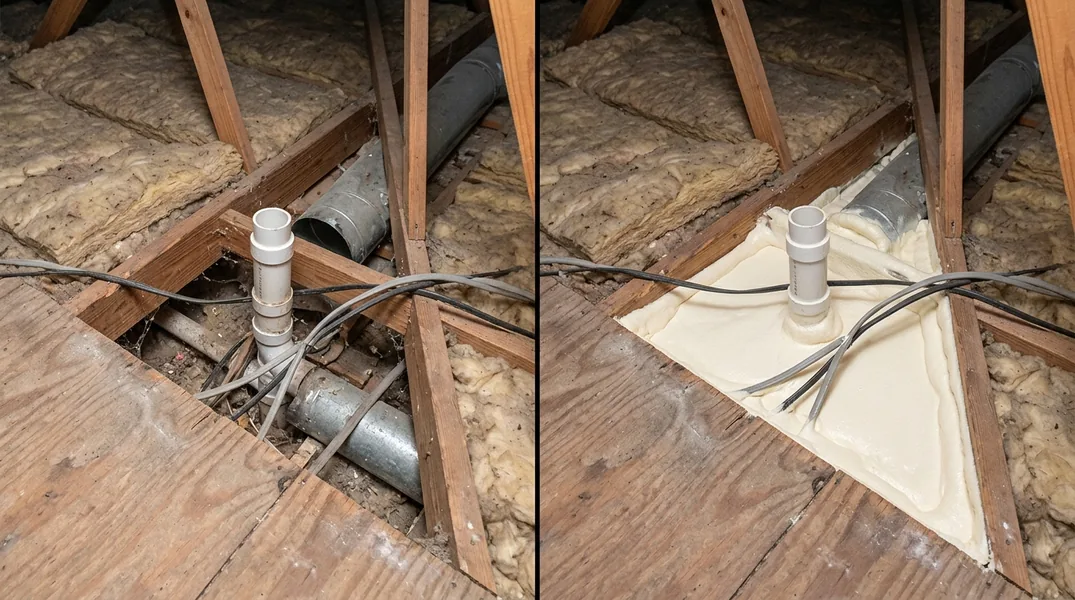
Understanding the Difference: Air Sealing vs. Full Foam Coverage
When homeowners in Lakeland think about improving their attic insulation, they often face a critical decision: should they focus on air sealing alone, or invest in comprehensive Attic Spray Foam Insulation? The answer depends on your home's current condition, your budget, and your long-term energy goals.
Air sealing is the process of identifying and closing gaps, cracks, and penetrations in your attic where conditioned air escapes. This might include sealing around electrical outlets, pipe penetrations, ductwork, and the attic hatch. While air sealing is essential and cost-effective, it addresses only part of the insulation puzzle. Full spray foam coverage, on the other hand, combines air sealing with continuous thermal resistance across your entire attic space, creating a more comprehensive barrier against heat transfer and energy loss.
The key difference lies in performance. Air sealing stops air leakage, which accounts for roughly 30 percent of energy loss in a typical home. However, conduction through existing fiberglass batts or blown-in cellulose still allows significant heat transfer. Closed Cell Spray Foam Insulation and Open Cell Spray Foam Insulation products address both air leakage and conductive heat loss simultaneously, making them a more complete solution for homeowners serious about energy efficiency.
Spray Foam Insulation R-Value Per Inch: What You Need to Know
One of the most important metrics when evaluating any insulation product is its R-value, which measures thermal resistance. Understanding spray foam insulation R-value per inch helps homeowners make informed decisions about which product suits their needs. Closed cell spray foam typically provides an R-value of 6.0 to 7.0 per inch, while open cell spray foam offers approximately 3.5 to 3.6 per inch. This difference is significant when determining how thick spray foam should be to meet your energy goals.
The higher R-value of closed cell foam makes it more efficient in tight spaces, but it also comes at a higher pricing point. Open cell foam is more affordable and still delivers excellent performance, especially in Lakeland's warm climate where summer cooling is a primary concern. Both types create an air barrier that prevents moisture infiltration, which is particularly valuable in Florida's humid environment. When comparing products, always ask your contractor about the R-value per inch so you can accurately calculate the total thermal resistance of your installation.
R-Value Requirements by State: Florida's Standards for Attic Insulation
Florida has specific building code requirements that dictate minimum R-value requirements by state for attic insulation. According to the Florida Building Code, attic insulation in most residential applications must achieve an R-value of R-30 or higher, depending on your specific location and the type of heating and cooling system in your home. For Lakeland homeowners, understanding these requirements ensures your installation meets code and qualifies for potential incentives.
Meeting Florida's R-value requirements by state is straightforward with spray foam. For example, if you use closed cell foam with an R-value of 6.5 per inch, you would need approximately 4.6 inches of material to achieve R-30. If you choose open cell foam at 3.6 per inch, you'd need about 8.3 inches. Both approaches are viable, but the choice affects installation depth, cost, and your attic's usable space. Many homeowners find that closed cell foam allows them to meet code requirements without consuming excessive attic headroom, making it an attractive option for homes with limited vertical space.
How Thick Should Spray Foam Be? Determining the Right Depth for Your Home
A common question from homeowners is: how thick should spray foam be? The answer depends on several factors including your R-value target, the type of foam selected, your climate zone, and your energy efficiency goals. While Florida's minimum code requirement is R-30, many energy-conscious homeowners in Lakeland choose to exceed this baseline and aim for R-38 or even R-49 for superior comfort and lower utility bills.
If you're installing closed cell foam, achieving R-30 requires about 4.6 inches of material. To reach R-38, you'd need approximately 5.8 inches. For open cell foam, the same R-30 requirement means roughly 8.3 inches, while R-38 requires about 10.6 inches. The thickness decision also affects your budget and installation timeline. Thicker applications provide better sound dampening, superior moisture control, and increased energy savings, but they cost more upfront. Your contractor should help you evaluate the return on investment for additional thickness based on your local utility rates and expected occupancy in the home.
It's worth noting that spray foam doesn't settle or compress over time like traditional fiberglass batts, so the R-value you achieve on installation day remains constant throughout the foam's 80+ year lifespan. This longevity makes the initial investment in proper thickness particularly valuable for homeowners planning to stay in their Lakeland home for decades.
Insulation Tax Credit and Rebates: How to Maximize Your Savings
One of the most attractive aspects of upgrading your attic insulation is the potential for financial incentives. The insulation tax credit allows homeowners to claim a credit on their federal income tax return for qualifying energy-efficient home improvements. As of recent tax years, homeowners may be eligible for a credit of up to 30 percent of the cost of certain insulation improvements, with a lifetime limit. An insulation tax credit can significantly reduce the net cost of your spray foam installation, making premium products more affordable than you might expect.
Beyond federal incentives, many utility companies in the Lakeland area offer insulation rebates to customers who upgrade their attic insulation. These rebates can range from a few hundred dollars to several thousand, depending on the program and the scope of your project. Some programs offer insulation rebates based on the R-value achieved or the square footage treated. Before starting your project, contact your local utility provider to inquire about available programs. When you request a free estimate from Lakeland Spray Foam Insulation, our team can also help you identify which incentives you may qualify for and ensure your installation meets all program requirements.
To claim an insulation tax credit, you'll typically need documentation of your installation, including receipts and proof that the materials meet Department of Energy standards. Most spray foam products used by professional installers qualify, but it's important to verify before beginning work. Taking time to understand both the insulation tax credit and available insulation rebates can reduce your out-of-pocket costs by 30 to 50 percent or more, making comprehensive attic insulation an even smarter investment.
Attic Spray Foam Insulation Cost in Lakeland: What to Budget
Understanding attic spray foam insulation cost in Lakeland helps you plan your budget and compare quotes effectively. Several factors influence final pricing, including the type of foam (closed cell versus open cell), the thickness required, your attic's square footage, existing conditions, and accessibility. On average, closed cell spray foam costs between 1.50 and 2.50 dollars per board foot, while open cell foam typically ranges from 0.60 to 1.25 dollars per board foot. For a typical 1,500 square foot attic, a complete closed cell installation might cost between 5,000 and 10,000 dollars, depending on thickness and local factors.
Open cell foam offers a more budget-friendly option, with complete attic installations often ranging from 2,500 to 5,000 dollars for similar square footage. While the upfront cost is lower, remember that open cell requires greater thickness to achieve the same R-value, so the difference in total material volume is less dramatic than the per-unit pricing suggests. When evaluating attic spray foam insulation cost in Lakeland, factor in long-term energy savings. Many homeowners recover their investment through reduced heating and cooling costs within 5 to 8 years, then enjoy years of additional savings. Call Lakeland Spray Foam Insulation at (863) 777-4948 to discuss your specific project and receive a detailed quote that accounts for your home's unique requirements.
Looking for a professional spray foam insulation contractor in Lakeland? Lakeland Spray Foam Insulation responds fast for all your spray foam insulation needs.
Get a Free Quote